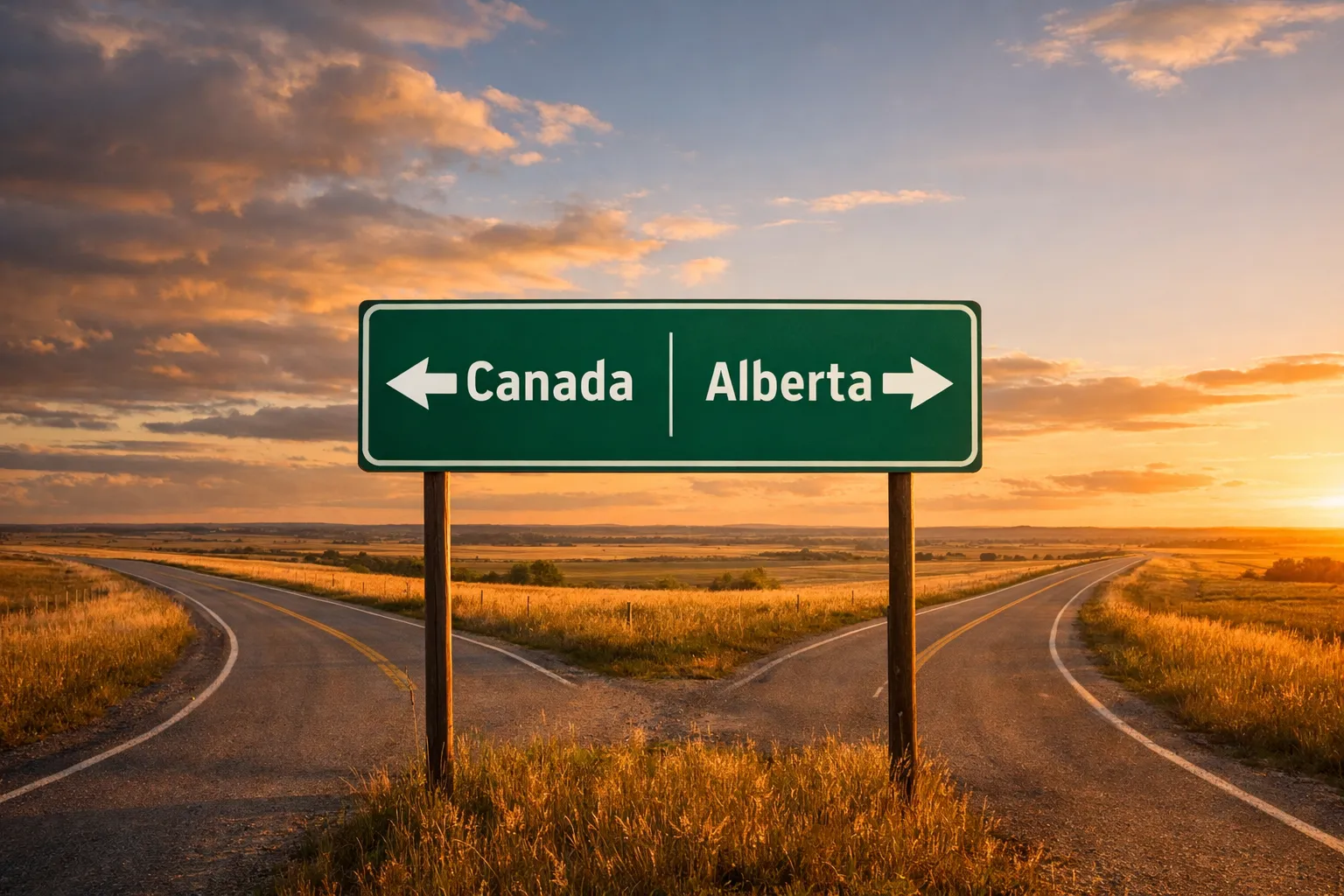
Alberta separatism isn’t a mood swing. It’s a verdict.
After ten years of Liberal rule—from Trudeau through Carney—Alberta has gone from grumbling about Ottawa to openly gamifying life outside Canada. The numbers aren’t fringe anymore, and Pierre Poilievre’s year-end sit-down with Brian Lilley put it in one clean sentence: after a decade of Liberal government “destroying the economy… attacking our natural resource sector… centralizing power in Ottawa,” separatist movements in both the West and Quebec are “strong and vibrant,” and his mission is to reunite the country.
The media heard the word “separatism” and immediately tried to make him the problem. The facts say otherwise.
The West wasn’t talking about leaving — until Ottawa gave them reasons
From eye-rolls about “Ottawa” to a real exit option
For most of modern politics, Alberta separatism was background noise. A T-shirt here, a grumble there, a protest bumper sticker and the odd crank party that never cracked double digits. The real separatist drama was always in Quebec.
That changed after a sustained stretch of Liberal government ruling from the centre while treating Alberta’s core industries like a moral embarrassment to be managed at arm’s length. Between carbon taxes, regulatory choke points, and a cultural sneer at oil and gas, the message from Ottawa was obvious: you’re the problem, we’re the conscience.
Pollsters started picking up what the talking heads missed. In the wake of the last federal election, an Angus Reid survey found roughly three-in-ten Albertans said that if the Liberals formed the next government, they would vote to leave Canada—either as an independent country or as part of a new federation. That’s not a crank fringe. That’s mainstream frustration crossing a line.
Other work shows the same pattern. A long-running research series on Alberta’s political attitudes documented how separatist sentiment surged after the 2019 federal election before settling closer to one in five, but still far above historic background levels. In other words, this isn’t a Twitter trend. It’s a measurable pressure valve.
When “leave” becomes normal, Ottawa has already failed
By 2025, the question stopped being “does separatism exist?” and became “how many people are quietly open to it?” One poll reported that about 36 percent of Albertans were at least leaning toward voting to leave Canada, and nearly two-thirds of UCP voters were in that camp.
Those are Brexit numbers. That’s Scotland-referendum territory. When roughly a third of a province—and a majority of its dominant provincial party’s base—are willing to tick “yes” on an exit question, you are no longer talking about fringe sentiment; you’re talking about a live option in the democratic marketplace.
Poilievre didn’t invent that. He’s acknowledging it. The people who did help build it are the ones who spent ten years telling Albertans their prosperity was a problem to be solved rather than a contribution to be valued.
Liberal policy turned anger into an organized exit lane
Ottawa’s “green virtue” vs Alberta’s paycheque reality
Ask Albertans why they’re fed up and you don’t get abstract theory. You get concrete hits: cancelled projects, stalled pipelines, investment scared off by ever-moving goalposts, and a federal political class that treats the oilpatch like a guilty secret while cashing the taxes it throws off.
That disconnect shows up in how Albertans talk about their place in Canada. Survey after survey finds majorities saying federal government actions could change their views on the province’s future in Canada, and that people in other parts of the country don’t understand why some Albertans feel alienated. Translation: “we’re not crazy; you’re not listening.”
Even in more academic work, the pattern is the same. Researchers tracking western alienation have described a “new form” of western discontent emerging around 2019, fueled by a sense that Ottawa is happy to harvest Alberta’s revenue while kneecapping the industries that generate it. That’s not some conservative war-room memo; that’s the university crowd admitting the obvious.
When even the premier is forced to talk referendum
Danielle Smith isn’t the one pushing separation, and she says so every time she’s asked. But the ground under her has shifted. In Ottawa political circles, she’s now openly described as asking the feds to help “quell the separatism debate” while refusing to block a citizen-led referendum if Albertans push it forward.
That’s how far things have gone. A sitting premier who grew up in a Canada-first conservative tradition now has to manage separatism like a live wildfire: she doesn’t want it, but she can’t pretend it isn’t burning.
Meanwhile, polling and political reporting both show that proposed referendum questions on Alberta independence are now serious enough for Elections Alberta to vet and approve, and serious enough for mainstream outlets to treat as real news, not fringe theatre. The basic gatekeepers of the system are acting like this could actually happen, because on the numbers, it could.
Poilievre is trying to patch a country the Liberals cracked
“One of my missions is to reunite the country”
In his conversation with Brian Lilley, Poilievre didn’t do the usual Ottawa dance. He didn’t pretend separatism is some weird irrational fever. He connected it directly to ten years of Liberal rule: economic damage, cost-of-living pain, hostility to the resource sector, and power increasingly centralized in Ottawa. Then he said the quiet part out loud: there are now “strong and vibrant… separatist movements in both the West and Quebec,” and one of his missions is to reunite the country.
That’s not “stoking division.” That’s describing division that already exists and promising to reverse it. The people who want him to stop talking about it aren’t defending unity; they’re defending their own deniability.
The polling backs his framing. Studies on sovereignty and separatism make it clear that separatist sentiment spikes when Liberals are in charge federally and softens when the possibility of a different government appears. In plain English: Alberta separatism is now a conditional threat aimed squarely at the people currently running the country.
The media asks if he’s “too divisive” — while ignoring what’s actually dividing people
While Poilievre talks about reuniting the country, much of the political media would rather recycle a safer story: that he is the one threatening national unity by daring to criticize the status quo. Instead of dealing with the polling—up to roughly a third support for separation, and majorities of UCP voters flirting with the exit—they talk about his tone.
That’s how you know the establishment is scared. If they engage with the substance, they have to admit that after a decade of Liberal leadership, a big chunk of Alberta is mentally halfway out the door. It’s easier to run panel segments about “dangerous rhetoric” than ask why ordinary Albertans might reasonably feel cheated by a federation that depends on their prosperity but despises the work that creates it.
Alberta separatism is a warning light, not a glitch
A third of the province flirting with the exit is the real “national unity crisis”
You don’t get to shrug off poll after poll showing one in three Albertans willing to vote “leave” and still call yourself a national government. That’s not an irritation. That’s a structural failure.
Liberal Ottawa can keep pretending Alberta separatism is some irrational tantrum, but the data says otherwise: support rises when the feds clamp down on the province’s economic lifeblood and lecture it from the centre; it falls when there’s at least the hope of a government that treats Alberta as a partner, not a problem.
Poilievre, whatever you think of him, has grasped the obvious: you can’t run a country this big, this different, and this angry by decree from Ottawa and expect everyone to smile politely forever. His promise to “reunite the country” is less a slogan and more a cleanup job description. Someone has to go out West and say, “We actually want you in this thing, and we’re done governing like you’re expendable.”
Right now, Alberta separatism is the dashboard light flashing “check engine” on the Canadian federation. The Liberals’ answer has been to tape over the light and accuse the mechanic of being divisive. Poilievre, at least, is saying out loud what the numbers already prove: if Ottawa keeps governing like this, Alberta won’t just threaten to leave—it will start looking for the door.
Sources & Reference Material
- Separatist sentiment? Three-in-10 in Alberta & Saskatchewan say they’d like to leave if Liberals form next government — Angus Reid Institute
- 36% of Albertans and majority of UCP voters want to leave Canada: new poll — CityNews Edmonton
- Alberta’s New Separatists — Maclean’s
- Bipartisan ‘cooler heads’ have vested interest in lowering the temperature on Alberta separatism: Calgary Liberal Hogan — The Hill Times
- WATCH: Pierre Poilievre and Brian Lilley discuss leadership, cost of living and the last year in politics — Brian Lilley