Ottawa just signed Canadians up for another $2.5 billion for Ukraine.
Not the first billion. Not the fifth. Just the latest line item in a war tab that’s already into the tens of billions.
You can support Ukrainians and still ask the obvious questions. In fact, most Canadians do exactly that. Polling shows a clear majority still backs some level of aid to Ukraine – including most Conservative voters – but that support is getting more conditional and more skeptical about how much, for how long, and with how little transparency.
That’s the ground this piece stands on: pro-Ukraine people, anti-corruption, and done being told that “solidarity” means suspending basic arithmetic and conflict-of-interest rules at home.
What Carney Just Signed Canada Up For
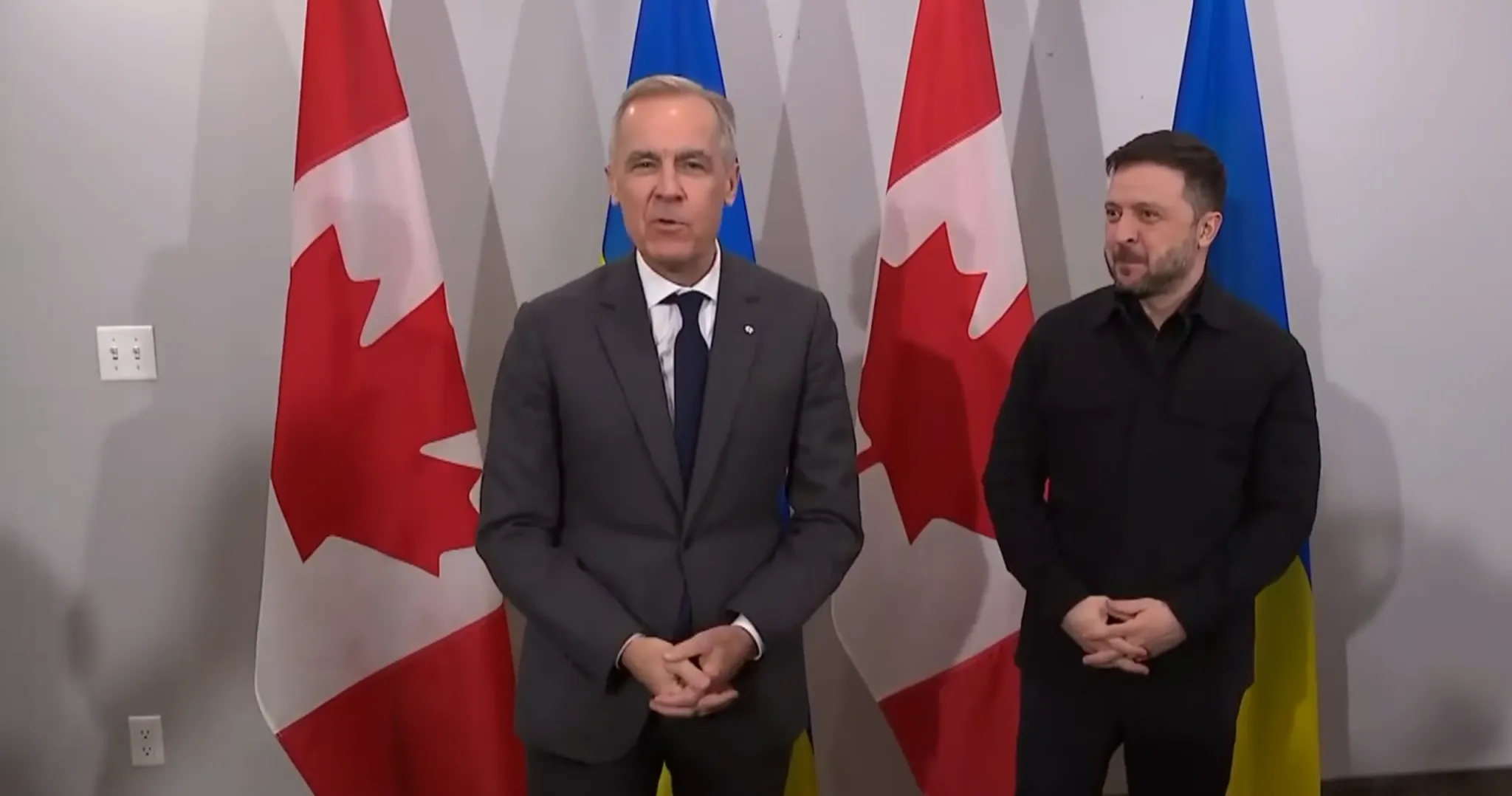
On December 27, 2025, Mark Carney announced an “additional $2.5 billion commitment for Ukraine.” The official breakdown is simple enough on paper: financing to let the IMF lend Ukraine more, Canada joining extended debt-service suspension for Ukraine, and a loan guarantee of up to $1.3 billion to the World Bank’s IBRD to support reconstruction.
Strip out the jargon and you get three moves. Ottawa borrows and routes money into IMF structures that then lend to Ukraine. It agrees to forego or soften payments Ukraine was supposed to send back to Canada. And it promises to cover part of the World Bank’s losses if Ukraine can’t pay its bill.
No, that’s not a pallet of cash flown to Kyiv tomorrow. But it’s also not free. Every piece sits on the federal balance sheet: more borrowing, less income, and new contingent liabilities. If the guarantee gets called, the institution that pays is called “the Government of Canada” – which is just a polite way of saying you.
Calling all of that “$2.5 billion in economic aid” is the political spin. The reality is “$2.5 billion more in taxpayer-backed risk.”
This Isn’t a One-Off – We’re Already Deep Into the Billions
Carney’s announcement treated the $2.5 billion as the next big “Canada steps up” moment. What most people don’t see in the headline is the running total behind it.
According to Global Affairs’ own numbers, Canada has already committed nearly $22 billion in assistance to Ukraine since Russia’s full-scale invasion in 2022. That includes military support, loans and other financial assistance to keep the Ukrainian state functioning, humanitarian aid, development programming, and supports for Ukrainians who fled here.
A big chunk of that is direct financial assistance: loans and budget support that plug straight into Ukraine’s public finances. On the military side, Canada has pledged multiple billions worth of equipment, training, and long-term support, with some of those commitments stretching years into the future.
Stack this new $2.5 billion on top of that and you’re into the mid-twenties in billions in less than four years. That is not a rounding error. That is a strategic fiscal choice.
So when Ottawa talks about “new” support as if each announcement exists in a vacuum, it’s leaving out the main story: Ukraine is already the single largest foreign file in Canada’s books. At this scale, the question isn’t “Do you care about Ukraine?” It’s “How many billions before Canadians get a full ledger instead of another photo-op?”
What Canadians Actually Think About All This
Here’s where we need to be precise.
An Abacus Data poll for the Ukrainian Canadian Congress in late 2025 found that roughly two-thirds of Canadians support continued assistance to Ukraine. That includes a majority of Conservative voters as well as overwhelming support among Liberal and NDP supporters. So yes, there is a broad moral baseline: most Canadians still support some form of help.
But that doesn’t translate into a blank cheque. When other national polling asks how much money should be going out the door, you see a different picture: many Canadians want support maintained but not increased, and a large share now thinks the federal government is already doing too much, not too little. The public’s position is basically: help, yes; unlimited, no.
In other words, the skepticism in this piece isn’t coming from some fringe corner. It’s where a growing chunk of the country already is – keep helping Ukrainians, but show the math and show the trade-offs.
The Country Writing Cheques Is Also Lining Up at Food Banks
Now set those billions against what’s actually happening inside Canada.
Food Banks Canada’s recent reporting paints an ugly picture. Food bank usage has roughly doubled compared to pre-2019 levels. Millions of visits a month. Record demand, year after year. And this isn’t just the very poorest: more and more working Canadians are showing up because their wages simply don’t cover housing, food, and basic bills anymore.
Food Banks Canada has started talking openly about poverty and hunger becoming “normalized” in Canada. Systems that were designed for short-term crisis response are being forced to operate as a permanent back-up welfare state. In their latest poverty report card, the federal government gets a barely-passing grade on actually reducing poverty and food insecurity.
So no, people watching yet another billion-plus package announced for Ukraine are not isolationists for asking questions. They are looking at a country where record food bank use is being baked into everyday life, and they are being told – by the same political class that just found $2.5 billion more for Ukraine – that there is “no fiscal room” for serious relief at home.
The issue isn’t charity versus selfishness. It’s priorities. If Ottawa can design intricate IMF-linked guarantee schemes for a foreign government, it can certainly figure out how to keep its own citizens from relying on emergency food boxes as a second welfare system.
Ukraine’s Corruption Problem Is a Risk Factor, Not a Slur
Here’s the grown-up view: Ukraine is fighting a real war against Russia and a long war against corruption. Both are true. Ignoring the second doesn’t help the first.
International corruption and governance indices have, for years, classed Ukraine as a high-risk environment. The country has improved its scores over the last decade and built new anti-corruption institutions, but it still sits well below the levels you’d associate with low-corruption, predictable public sectors. Even the optimistic commentary from watchdogs admits the problem: entrenched graft, weak state institutions, and constant pressure points around big public contracts and defence procurement.
Acknowledging that doesn’t make you anti-Ukraine. It makes you literate.
What it does mean is that any large flow of money into that system – whether via IMF programs, World Bank lending, or bilateral guarantees – should come with extreme transparency and strict conditions. Governance-risk indicators don’t tell you “never send a dollar”; they tell you how thick the paper trail needs to be and how many independent auditors should be crawling over the numbers.
Sending billions into a high-risk environment with vague public reporting isn’t solidarity. It’s negligence dressed up as virtue.
The Brookfield Shadow Over the PMO
Now add the part Ottawa really doesn’t want to talk about: the prime minister’s own financial interests.
Mark Carney used to sit at the top of Brookfield Asset Management. He left with significant Brookfield-linked holdings, and his disclosure to the Conflict of Interest and Ethics Commissioner confirms it. The Commissioner and Carney agreed to a formal “conflict of interest screen” that is supposed to stop him from taking part in decisions that could further his interests, or those of Brookfield and certain other named companies.
On paper, that sounds reassuring. In practice, there are two obvious problems. First, the screen still allows him to participate in decisions that affect a “broad class” of companies – which is exactly the kind of language that swallows almost everything important in Ottawa. Second, he still benefits financially if Brookfield’s value rises, because he kept stock and options rather than cutting clean ties.
At the same time, Brookfield is not some sleepy holding company. It is a major global player in infrastructure and energy, invested in firms that have deep business in Ukraine’s energy and reconstruction space, including nuclear. That means Carney’s personal upside is indirectly exposed to how well Ukraine’s long-term reconstruction goes – and to how much global capital, public and private, ends up flowing into that ecosystem.
You don’t have to draw a cartoon arrow from “$2.5 billion Canada” to “Brookfield’s bottom line” to see the problem. The prime minister still has a performance-linked stake in a group with big interests in the market he’s now pouring public guarantees into. Ethics screens or not, that is a conflict-of-interest minefield.
Maybe every decision was handled perfectly. Maybe he recused from every file where Brookfield could benefit. Fine. Then Ottawa should be able to show, in detail, which meetings he was screened out of, which memos he didn’t sign, and how the line between his private upside and public decisions was policed in practice.
If they can’t show that, they’re not asking for trust. They’re demanding blind obedience in a situation that would get any mid-level bank employee fired on the spot.
The Transparency Test Ottawa Keeps Failing
To be fair, Canada does have a basic oversight skeleton.
Global Affairs produces a Report to Parliament on International Assistance and a separate Statistical Report that are supposed to give a comprehensive breakdown of where aid dollars go. There are also online tools – dashboards and open data – that, in theory, let anyone trace international assistance project by project.
On paper, that sounds respectable. In reality, it’s a maze of backward-looking PDFs and datasets that almost no ordinary Canadian will ever see. The reports aren’t written in normal language, they rarely connect clearly to the big round numbers politicians announce, and they certainly don’t answer the obvious questions about this specific $2.5 billion package.
For this commitment alone, Canadians should be given – plainly, in one place:
Who is responsible for each part of the package. How much is IMF-linked financing, how much is debt-service relief, and how much is loan guarantees. What assumptions officials are making about default risk. When and where the results will be reported publicly. What success is supposed to look like on the ground, in terms of timelines and outcomes.
That’s not “micro-managing foreign policy.” That’s the minimum level of disclosure you’d expect from any organization that just took on billions in new obligations. If your government can’t or won’t do that, the problem isn’t “disinformation.” The problem is your government.
Supporting Ukrainians Means Demanding Receipts
So where does that leave you if you support Ukrainians but don’t buy blank cheques?
Start with the basics. Canada has already committed close to $22 billion to Ukraine since 2022 and has just bolted another $2.5 billion on top in the form of loans, forgone repayments, and guarantees – all of it ultimately backed by Canadian taxpayers. This is happening while food bank usage at home has exploded, and national charities warn that poverty and hunger are being normalized in a supposedly wealthy country.
Polls show most Canadians still support helping Ukraine. They also show growing discomfort with the scale and duration of that support, and deep suspicion of the idea that Ottawa can always find another billion for far-away causes but never quite manage to fix the basics at home.
Layer on top of that a prime minister whose personal wealth is entangled with a global asset manager invested in Ukraine-linked energy, and whose own ethics screen admits that decisions affecting a broad class of companies can still cross his desk, and you have a simple conclusion.
You can stand with Ukrainian civilians and still demand that every Canadian dollar committed in their name comes with a tracking number, a timeline, and independent verification. You can oppose Putin and still say a prime minister with deep Brookfield ties has no right to ask for blind trust when he’s structuring billions in Ukraine financing. And you can absolutely look at normalized hunger in your own country and ask why “urgency” seems to be something this government only discovers when the money is going somewhere else.
Supporting allies and demanding receipts are not opposites. In a high-deficit, high-hardship Canada, transparency isn’t optional – it’s the permission structure for public trust. Right now, Mark Carney is spending the trust faster than the money.
Sources & Reference Material
- Prime Minister Carney announces new support for a just and lasting peace in Ukraine — Prime Minister of Canada
- Canada–Ukraine relations and assistance since 2022 — Global Affairs Canada
- HungerCount and poverty/food insecurity reporting — Food Banks Canada
- Public opinion on Canadian support for Ukraine (UCC/Abacus survey and national polling) — Ukrainian Canadian Congress
- Carney conflict-of-interest screen and Brookfield holdings — iPolitics