
The January cold in Central Alberta has a way of clarifying political priorities. In Red Deer and Eckville, as temperatures plummeted, the lines remained. These citizens were not gathered for a commercial event or a government handout; they were waiting—often for up to three hours—to exercise a manual, legally grueling act of self-determination. Under the observation of registered canvassers, thousands of Albertans are currently participating in the “A Referendum Relating to Alberta Independence” petition.
Launched on January 3, 2026, by Stay Free Alberta, the petition seeks to trigger a formal provincial vote on secession. The math is straightforward, yet the logistical requirements are intentionally prohibitive. Organizers must secure 177,732 original, witnessed physical signatures by May 2, 2026. This is not a digital campaign of “click-tivism.” It is a labor-intensive process that requires a level of physical endurance and commitment that the federal political establishment frequently ignores.
The mid-January turnout at Red Deer’s Festival Hall and the Eckville Legacy Centre indicates a shift from general discontent to disciplined coordination. While the “Forever Canadian” counter-petition recently claimed over 400,000 signatures in favor of maintaining the confederation, the comparison lacks context. Signing an online “stay” petition from a heated office is a low-friction endorsement of the status quo. Standing for hours in a January freeze to sign a document already preemptively labeled “unconstitutional” by the judiciary suggests a deeper, more resilient conviction.
This movement has moved beyond historical grievances over equalization or federal overreach. The energy in these lines is fueled by a sense of systemic exclusion. For those waiting in the cold, the Canadian project is no longer merely failing; it is being actively dismantled. As they look toward Ottawa, they do not see a government attempting to preserve national unity, but a technocratic administration acting as a primary catalyst for separation.
The Recruiter-in-Chief
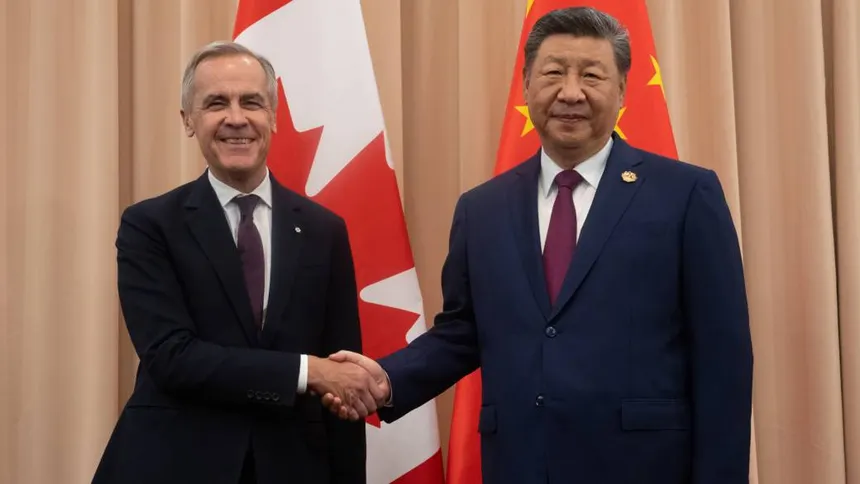
If the independence movement required a strategic benefactor, it has found one in Prime Minister Mark Carney. While Carney presents himself as a steward of stability, his policy trajectory has generated more Western alienation than the carbon taxes of the previous decade. His recent diplomatic efforts in Beijing, framed as a “strategic recalibration” within a “New World Order,” have served as a tipping point for the West.
As the United States—Canada’s essential trading partner—moves toward energy independence and protectionist trade blocks, Carney has spent his tenure pitching “green technology co-operation” and Energy MOUs to the Chinese government. To the Alberta workforce, this is an act of economic betrayal. The Prime Minister appears willing to trade Western energy security for a minor role in a globalist hierarchy, even as that same Chinese regime continues to target Canadian agriculture and resource exports with arbitrary restrictions.
Carney’s rhetoric concerning a “new era of partnership” with Beijing is an ideological insult to an industry he has previously characterized as a “legacy asset” in decline. For those in the three-hour lines, Carney represents an elite class that views the managed decline of the Canadian economy as an acceptable price for international prestige. When the Prime Minister discusses “diversification,” Albertans hear a plan to decouple from the North American trade relationships that sustain their province.
In this environment, separation is no longer discussed as a radical emotional reflex. It is being analyzed as a survival strategy. If the federal leadership is perceived to be intentionally steering the national economy toward a Beijing-centric model while dismissing domestic resource development, secession begins to look like the only rational recourse for economic preservation.
The Poilievre Alternate: What Might Have Been
The current crisis is sharpened by the “what if” of the 2025 election. Had Pierre Poilievre secured a mandate, the political calculus in Red Deer would likely be different. A Poilievre administration would have arguably attempted to reform the federation from within, focusing on productivity, the elimination of internal trade barriers, and the expansion of the resource sector.
Under such an administration, the grievances fueling Stay Free Alberta could have been addressed through a federalism that respects provincial jurisdiction. Poilievre’s approach offered a path to national stability through economic repair. Carney, by contrast, appears to view the current structure as obsolete. He is not attempting to fix the vehicle; he is managing its liquidation. This shift from potential reform to active dismantling has removed the middle ground. The choice for many is no longer between different versions of Canada, but between a controlled decline under Carney or a high-risk independent future.
The Legal Gauntlet
The federal establishment has not relied on rhetoric alone; it has utilized the judiciary as a primary defensive perimeter. In December 2025, Justice Colin Feasby ruled the proposed referendum unconstitutional. The court supported several First Nations—including signatories of Treaties 6, 7, and 8—who argued that Alberta cannot unilaterally alter Treaty obligations or establish an international border that would impact Indigenous mobility and land rights.
Justice Feasby’s ruling coincided with the provincial government’s introduction of Bill 14, the Justice Statutes Amendment Act, which sought to limit the court’s ability to block such initiatives. The judge’s description of the government’s actions as a “cavalier disregard for the rule of law” has provided the “Forever Canadian” camp with its primary legal argument.
However, if the judicial and political classes believe that a court ruling can suppress the frustrations of an economically marginalized population, they have misread the situation. To the thousands waiting in line, legal obstacles are merely further evidence of “elite insulation”—a system where the rules are perceived to be calibrated by those who benefit from the status quo. When the courts and the Prime Minister’s Office align to inform a province that there is no legal exit from a failing partnership, they do not encourage loyalty; they confirm the necessity of the struggle.
The Inevitable Verdict
The May 2, 2026, deadline is a significant milestone, but the outcome of the signature count is only part of the story. The lines themselves represent a fundamental fracture in the Canadian social contract.
On one side is a technocratic elite, led by Mark Carney, who views regional interests as secondary to a globalized agenda of trade and climate compliance. On the other are the citizens in Red Deer and across Alberta, who believe that a government’s primary responsibility is the prosperity of its own people.
While the “Forever Canadian” petition may boast a higher volume of signatures, the independence petition represents a higher degree of commitment. It is effortless to sign a digital form to maintain the status quo. It is an entirely different matter to stand for hours in a frozen parking lot to demand a break from it. These lines are not a mere protest; they are a definitive statement of intent. If Ottawa continues to treat the West as a commodity to be bartered in international forums, the number of signatures will be the least of its concerns.
Sources & Reference Material
- New Citizen Initiative Petition Issued — Elections Alberta
- Hundreds turn out in Red Deer for Alberta independence petition — CityNews
- Carney calls it a new world order, investors see an old question on China risk — Wealth Professional
- Court Finds Proposal for Alberta Independence Contravenes Treaties — Olthuis Kleer Townshend LLP
- Forever Canada petition opposing Alberta separation has signature goal verified — CKOM / The Canadian Press