The era of Canadian diplomatic middle-management has officially collided with the reality of Great Power competition. On Saturday, January 24, 2026, U.S. President Donald Trump utilized Truth Social to issue a final ultimatum to Ottawa. Referring to Prime Minister Mark Carney as “Governor”—a calculated jab at Carney’s past as a central banker and an implication of his subservience to foreign interests—Trump threatened a 100% across-the-board tariff on all Canadian exports if Canada proceeds with its pivot toward Beijing.
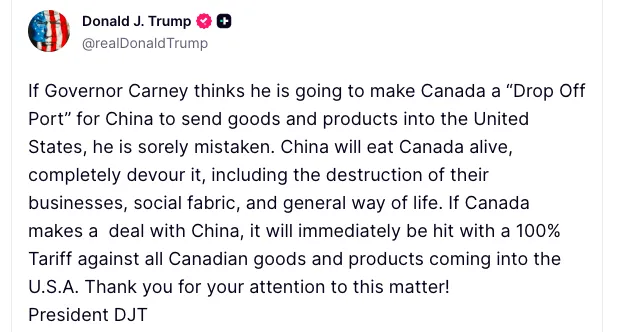
This is not a routine trade dispute. It is an existential threat to the Canadian standard of living, triggered by the Carney government’s attempt to play both sides of a deepening geopolitical divide. The President’s message was clear: if Carney intends to turn Canada into a “Drop Off Port” for Chinese goods seeking back-door entry into the American market, the U.S. will respond by effectively severing the bilateral trade relationship that sustains our national economy.
The “diversification” fantasy championed by Liberal supporters requires a cold reality check against current trade data. As of the most recent 2026 reporting, Canada’s economic dependence on the United States remains absolute. Approximately 76.4% of all Canadian goods are exported to the U.S. market, whereas exports to China account for a mere 3.8%. The asymmetry is so profound that it renders any “pivot” to China mathematically impossible. Even with the promised $3 billion in new agricultural orders, the scale is laughably insufficient to replace American demand.
A 100% tariff from the United States would not merely be a “headwind”; it would be a total wipeout of the Canadian industrial base. Economic modeling from Global Affairs Canada and provincial watchdogs suggests such a move would vaporize roughly 25% of Canada’s entire GDP within a single fiscal cycle. While the Carney administration talks about “strategic partnerships” in Beijing, they are gambling with the primary source of Canadian wealth in exchange for a market that has shown zero inclination to replace American demand.
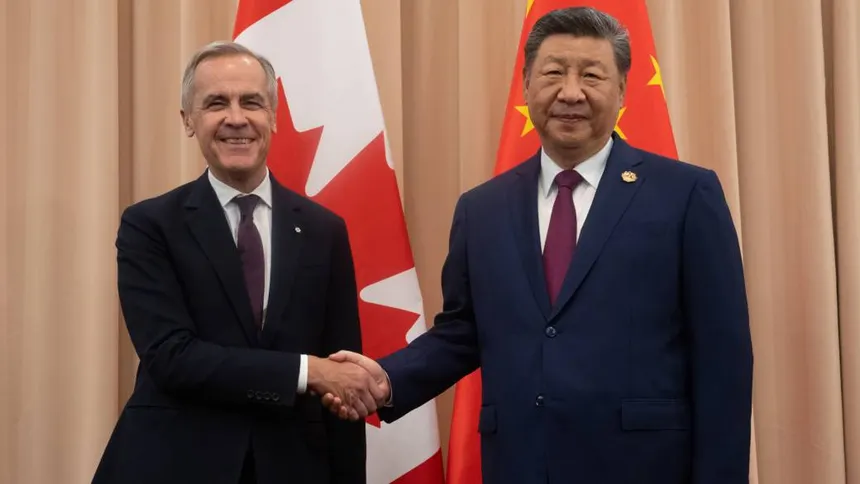
The catalyst for this escalation is the “EV Racket” orchestrated by the Prime Minister. On January 16, 2026, Carney signed a deal in Beijing that effectively ended the 100% surtax on Chinese electric vehicles, dropping the rate to a negligible 6.1%. The agreement includes a quota of 49,000 Chinese EVs per year—equivalent to roughly 3% of the total Canadian market—a move Carney claims will lower costs for Canadians. In reality, it signals to Washington that Canada is willing to break ranks with North American industrial security to appease Chinese state-owned enterprises.
Worse still is the timeline. The deal allows this quota to scale up to 70,000 vehicles within five years, specifically targeting the “affordable” segment with prices under $35,000. By facilitating this entry, the Carney government is essentially providing a beachhead for Beijing to hollow out the southern Ontario automotive corridor. It is a policy that sacrifices the high-paying jobs of Canadian autoworkers for the political optics of “green” affordability.
This policy shift stands in direct opposition to the U.S. demand for Canada to join the “Golden Dome” missile defense system. While the Trump administration seeks to integrate North American security through a $175 billion space-based shield over Greenland, the Carney government is instead inviting Chinese technology into our critical infrastructure. Carney’s dismissal of the project as a “protection racket”—a sentiment echoed by his UN Ambassador Bob Rae—has been met with predictable fury in Washington.
The resulting panic in Ottawa has been as immediate as it is transparent. By Saturday afternoon, Trade Minister Dominic LeBlanc was forced into a desperate damage-control exercise, issuing a statement claiming that Canada is “not pursuing a free trade deal” with China, but merely “resolving tariff issues.” This semantic walkback is the unmistakable signal of a government that realized too late it had overplayed its hand. Attempting to rebrand a massive strategic concession as a routine administrative fix is a tactic that will fool no one in Washington; it is a defensive reflex from a cabinet that has correctly identified its own obsolescence.
The “Governor” label reflects a view that Carney has traded Canadian sovereignty for a Beijing partnership, choosing short-term Chinese investment over long-term continental security. Trump’s recent removal of Canada from his “Board of Peace” is merely the diplomatic appetizer. The real consequence is the looming closure of the world’s most successful trade border.
The choice before Ottawa is now binary. Canada can function as a sovereign North American partner, integrated into the most prosperous trading bloc in human history, or it can attempt to become a Chinese satellite state at the cost of its existing economy. The Liberal belief that we can maintain our U.S. access while facilitating Chinese market dumping is a dangerous delusion.
The 100% tariff threat is the final warning. If the Carney government continues its trajectory toward Beijing, the American border will effectively close to Canadian industry. There is no third option, and there is no room for further bureaucratic hedging. We either secure our position in North America or we prepare for a generation of economic ruin.
Sources & Reference Material
- Trump calls PM ‘Governor Carney,’ threatens huge tariffs over China trade deal — THE CANADIAN PRESS
- Trump threatens Canada with 100% tariff over its China trade deal and escalates feud with Carney — ASSOCIATED PRESS
- LIVE UPDATES: Trump calls Carney ‘governor’ and threatens 100% tariffs — CTV NEWS
- Trump threatens Canada with 100% tariffs over its new trade deal with China — MODERN DIPLOMACY
- Quarterly Economic and Trade Report: Winter 2026 — GLOBAL AFFAIRS CANADA